
Corporate Uniform and Workwear Suppliers in Oman: How to Prepare an RFQ
Corporate Uniform and Workwear Suppliers in Oman: How to Prepare an RFQ
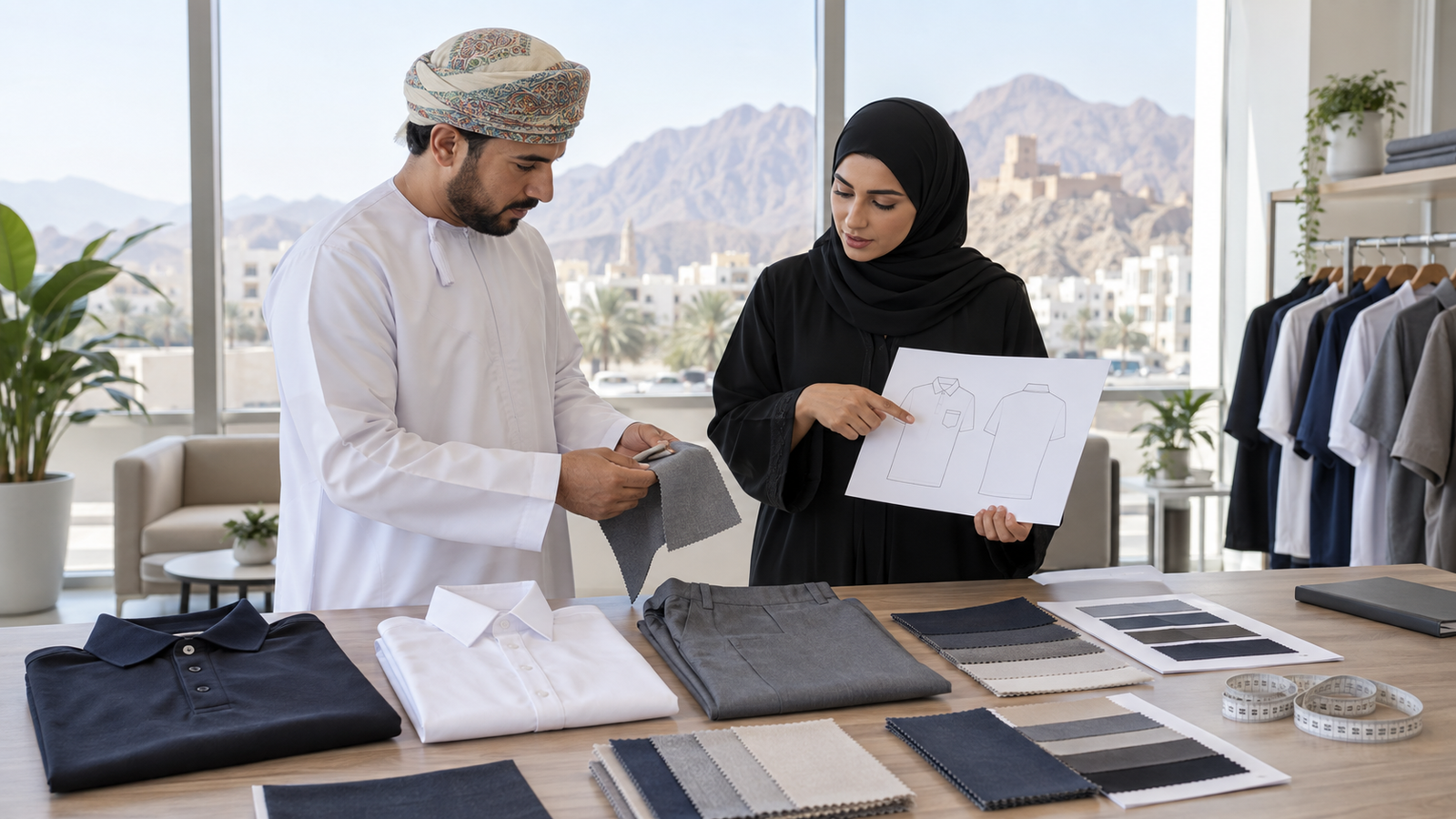
A useful request for quotation for corporate uniforms does more than state a total number of shirts or trousers. Suppliers need a role-by-role schedule, sizes, garment details, colour and branding instructions, while the buyer needs a controlled process for samples, artwork, substitutions, delivery and repeat orders.
Current supplier pages show that uniforms and customized workwear are available in Oman, but they do not establish one standard fabric, minimum quantity, lead time or production process. Prepare one written RFQ and ask every shortlisted uniform supplier in Oman to identify its assumptions and alternatives.
Build a role and quantity schedule
Start with the people who will wear the garments. Create a row for each department or job role and record:
- role or department;
- garment type and number of pieces per wearer;
- male, female or unisex cut where relevant;
- working environment and ordinary movement needs;
- preferred colour and appearance;
- estimated size range;
- initial quantity;
- spare or replacement quantity;
- delivery location; and
- target delivery date.
Do not combine front-desk staff, field teams, drivers, housekeeping or other groups into one line if they require different garments. A role schedule makes it easier to obtain the right samples and prevents a supplier from quoting a single generic item for everyone.
Specify garments, sizing, fabric, colour and branding
Describe each item clearly enough for suppliers to quote comparable products.
Garment specification
State the garment category, style, sleeve length, pockets, fastening, colour and any functional design requirement that is part of ordinary use. If you already have an approved garment, attach photographs and measurements, but do not assume a supplier can reproduce it exactly without a sample and written specification.
Fabric information
Ask the supplier to state the proposed fabric composition, weight or other product identifier it uses, along with available colours and care information. If a substitution is offered, require the alternative to be identified before approval. Do not make a durability, colourfastness or performance claim without exact product documentation.
Sizing
Ask how the supplier records measurements and converts them into its size system. A label such as medium or large may fit differently across products. For a mixed workforce, request a size chart and consider a fitting or size-set process before confirming quantities.
Branding
Provide the logo in the file format requested by the supplier and specify placement, dimensions, colours and branding method. Embroidery and printing can look different on different fabrics, so approve a physical sample or production-representative proof when the supplier offers one.
Request samples, a size set and an artwork proof
Use a staged approval process:
- approve the proposed garment or fabric sample;
- review the available size chart or size set;
- confirm quantities by size;
- approve the logo artwork, placement and colours;
- approve a branded sample or equivalent proof if offered;
- sign the final specification and quantity schedule; and
- authorize production only after all changes are recorded.
Keep a copy of the approved reference. Record the product code, fabric description, colour reference, logo position and approval date so future orders can be compared with the original.
Compare minimums, substitutions, production, delivery and reorders
Commercial terms vary, so request them in writing rather than treating them as market standards.
| RFQ field | What the supplier should confirm |
|---|---|
| Quoted item | Product code or clear garment description |
| Quantity | Total and quantity by size |
| Minimum order | Any minimum by garment, colour, size or branding method |
| Sample | Availability, cost, return status and approval process |
| Branding | Method, setup requirements and proof process |
| Substitutions | Whether changes require buyer approval |
| Production | Stages and estimated timing for the stated order |
| Delivery | Location, split delivery options and inspection process |
| Replacement sizes | Process for exchanges or additional sizes |
| Reorders | Whether the same product reference can be requested later |
| Quote validity | Date until which the commercial proposal applies |
If a supplier proposes an alternative fabric, garment or branding method, ask for a revised sample and written specification. Do not approve an unnamed “equivalent.”
Prepare for repeat orders
Uniform programs often continue after the initial delivery because employees join, sizes change or garments need replacement. Ask suppliers:
- how later quantities are ordered;
- whether small repeat orders are accepted;
- whether the same product and colour reference is expected to remain available;
- what happens if a fabric or garment is discontinued;
- whether archived artwork and logo settings are retained;
- how replacement sizes or incorrect items are handled; and
- how the buyer should identify the original approved specification.
Continuity cannot be guaranteed from a product page. Record the supplier’s written process and keep your own approval files.
Corporate-uniform RFQ template
Please quote for corporate uniforms for [company/department] in Oman. The attached schedule lists each role, garment, cut, quantity by size, colour, fabric preference, logo placement and delivery location. Please identify the proposed product and fabric, provide a size chart, and state the sample, fitting and artwork-proof process. Confirm minimum quantities, permitted substitutions, production and delivery terms, packaging, inspection, replacement-size handling, repeat-order process, quote validity and all optional charges. No change to garment, fabric, colour, branding or quantity may be made without written approval.
Ask every shortlisted supplier to respond to the same fields. A lower total is not directly comparable if the garment, fabric, branding, size process or delivery scope is different.
Claims that require product-specific documents
Ordinary corporate clothing should not be described as personal protective equipment merely because it is called workwear. Claims involving flame resistance, high visibility, chemical resistance, antistatic performance, medical protection, food-safety suitability or compliance with a standard require exact product documentation and qualified review.
If your roles genuinely require protective clothing, run a separate procurement process based on a competent risk assessment and the applicable product documents. Do not rely on a general uniform catalog or logo sample.
Frequently asked questions
What should be included in a corporate-uniform RFQ?
Include roles, garment types, cuts, quantities by size, fabric and colour preferences, logo details, samples, fitting, proof approval, substitutions, delivery locations, replacement sizes and reorder terms.
Should I request a full size set before ordering?
Ask what size-set or fitting options the supplier offers. Size labels can vary between garments, so a size chart and practical fitting process can reduce avoidable exchanges.
How should logo embroidery or printing be approved?
Provide an approved logo file and specify placement, size and colours. Review an artwork proof and, when available, a physical branded sample before authorizing production.
What should I ask about replacement sizes and repeat orders?
Ask about exchanges, additional quantities, minimums for repeat orders, retained product references, discontinued items, archived artwork and expected colour or fabric continuity.
Can ordinary workwear be described as PPE?
Not without exact product evidence. Protective-performance and standards claims require product-specific documentation and qualified review; general corporate uniforms should not carry those claims.
Sources
Fact-checked: 2 October 2026. This article provides general procurement guidance. Products, samples, sizes, minimum quantities, production schedules, delivery and repeat-order terms vary by supplier and can change. Verify the final specification and commercial terms in writing. Protective-clothing requirements need separate competent and product-specific review.
